
The benefits of the lump-sum taxation regime in Switzerland
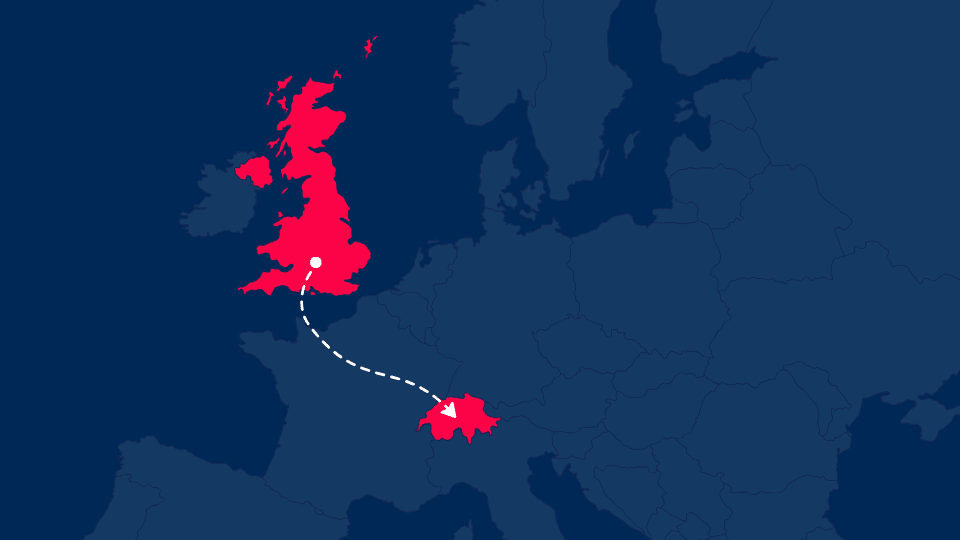
As of April this year, the United Kingdom will be introducing significant changes to the “non-dom resident” regime, making it less attractive. Similarly, Portugal will implement comparable changes to its “non-habitual resident” regime from the end of April 2025.
In light of these evolving international tax frameworks, it is an opportune moment to consider the Swiss equivalent: the lump-sum taxation (also referred to as “expenditure-based taxation” or “forfait regime”). This system allows foreign taxpayers to be taxed on a simplified and fixed basis, calculated according to their living expenses rather than their worldwide income and wealth.
Our team of specialists has built extensive experience over the years in negotiating such lump-sum agreements. You can rely on our expertise to help you navigate this complex tax environment.
Eligibility conditions
To qualify for lump-sum taxation, the taxpayer (or both spouses if married) must meet all of the following conditions:
1. Not hold Swiss nationality;
2. Be subject to unlimited tax liability in Switzerland for the first time, or after an absence of at least ten years;
3. Not engage in any gainful activity in or from Switzerland.
This tax regime must be requested by the taxpayer, either before his/her arrival in Switzerland or at the latest, prior to his/her first taxation.
Calculation of the tax basis
The lump-sum amount is agreed upon with the relevant cantonal tax authority and is set as the highest of the following three figures:
1. Seven times the deemed rental value of the property acquired by the taxpayer in Switzerland (as assessed by the competent authorities), or seven times the annual rent if the taxpayer is renting a property;
2. The taxpayer's total annual worldwide living expenses (including taxes);
3. The minimum tax base set forth by the law (as indicated in the following chart):
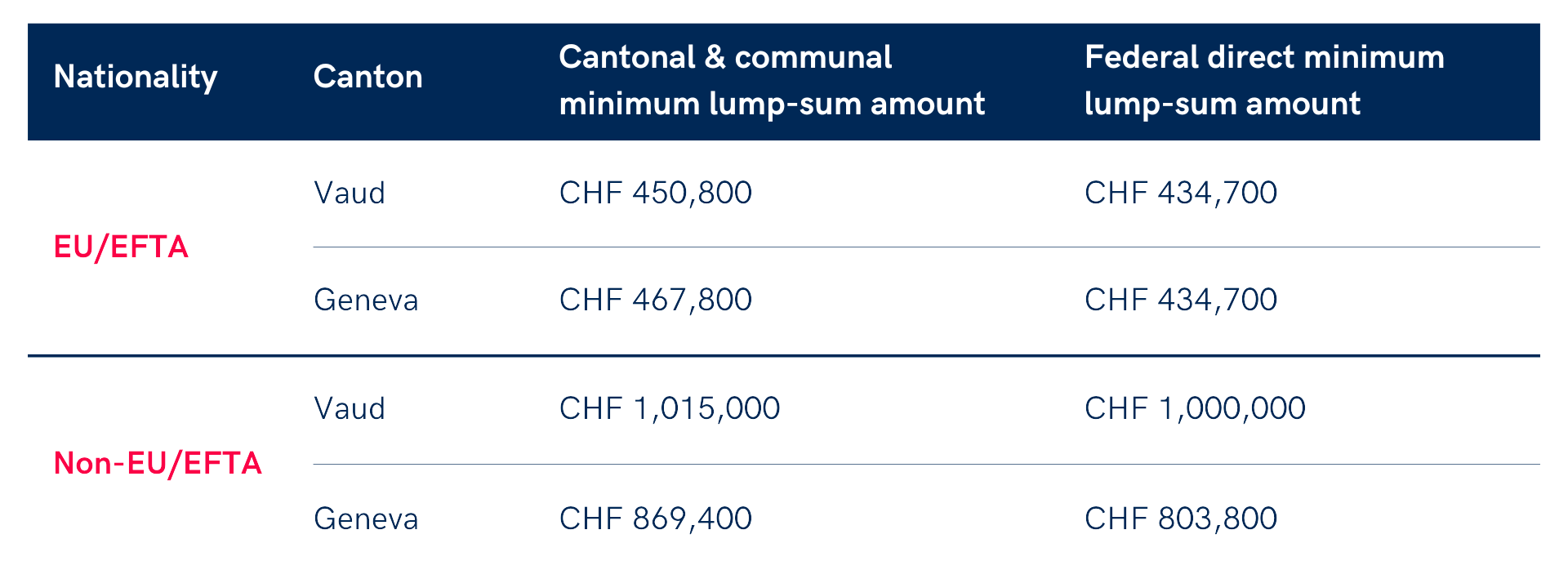
In addition, when completing the tax return, the tax due on the basis of the lump-sum shall be compared with the tax theoretically due on the taxpayer's Swiss income and assets (so-called “control calculation”). If the amount of tax resulting from the control calculation is higher than the amount of tax due on the lump-sum, the control calculation takes precedence.
Interaction with double taxation agreements
In principle, taxpayers under the lump-sum regime may benefit from Switzerland's double taxation treaties. However, certain treaties (notably with Germany, Austria, Belgium, Italy, Norway, the United States, and Canada) only apply if income from these countries is subject to taxation in Switzerland.
Comparison between lump-sum taxation and ordinary taxation (Example)
Mrs. Wagner, a retired German national, has until now resided in the United Kingdom under the “non-dom” regime. She decides to relocate to the canton of Geneva in 2025. Her assets-exclusively non-Swiss securities-amount to CHF 30 million, generating an annual return of CHF 1,5 million. She purchased a house in Collonge-Bellerive, where she now resides. The property has been valued by the tax authority at CHF 3 million, with a deemed rental value of CHF 80,000 per year. Her annual living expenses (excluding taxes) amount to CHF 350,000 per year. The tax comparison is as follows:
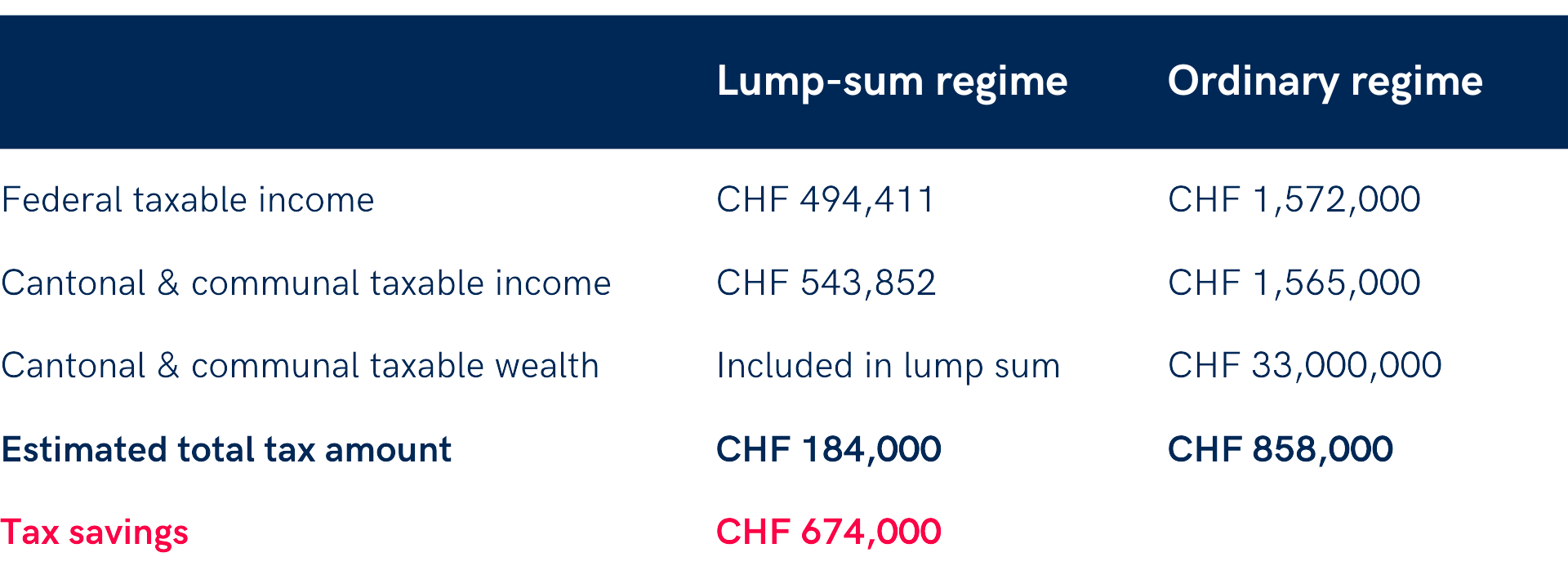
While some countries are significantly tightening their tax regimes, Switzerland continues to offer attractive opportunities through the lump-sum taxation. This regime involves specific procedures and requires close monitoring. Our tax team, with its solid track record in negotiating such arrangements, is available to answer your questions and support you throughout every step of the process.
Latest news

Taxation of married couples: a new vote
The taxation of married couples is at the heart of the Swiss tax debate. While individual taxation was accepted in March, a new vote is scheduled for November 29, 2026. What are the two proposed models and their implications for taxpayers? Our experts provide an overview.

Why use a broker for your business?
After nearly 20 years in insurance, Julien Gourdet joined Berney Associates to develop new expertise in brokerage. He explains why a company benefits from using a broker, how he supports his clients, and what sets him apart from an insurance agent.

Business insurance: too late to review your contracts?
Your company’s insurance contracts are coming to an end and the termination period has passed? Many companies think they have to wait another year. However, a premium increase or a negotiated postponement often allow you to act even sooner. Here’s how to check your options and prepare for a competitive bid in good conditions.
 Français
 English (UK)
 Deutsch