
The taxation of digital platforms at VAT

The new VAT tax provisions that came into force on 1 January 2025 aim to modernise and simplify the Swiss VAT system while strengthening the fight against tax fraud. One of the major changes of this reform concerns digital platforms.(1)
Indeed, from 2025, and under certain conditions, entities facilitating the sale of goods via digital platforms are deemed to have supplied these goods themselves, thereby becoming responsible and liable for VAT when the services are located in Swiss territory.
Creation of a legal fictional work
If a platform operator facilitates a delivery by connecting a seller and a buyer by means of a digital platform in such a way that they can conclude a contract for the sale of goods amongst themselves on the platform, the said operator is deemed to be the service provider in relation to the buyer (Art. 20a of the VAT Act).
The conditions for applying this legal fiction according to Art. 20a of the VATA Ordinance are therefore as follows:
- The basic transaction constitutes a sale of goods for VAT purposes; ;
- The platform operator connects the seller and the buyer by means of the platform; and
- The sale is concluded through this platform.
If the conditions are met, from a VAT perspective, there are not one but two supplies:
- first delivery between the seller of the property and the platform operator; ;
- second delivery between the platform exhibitor and the buyer of the property.
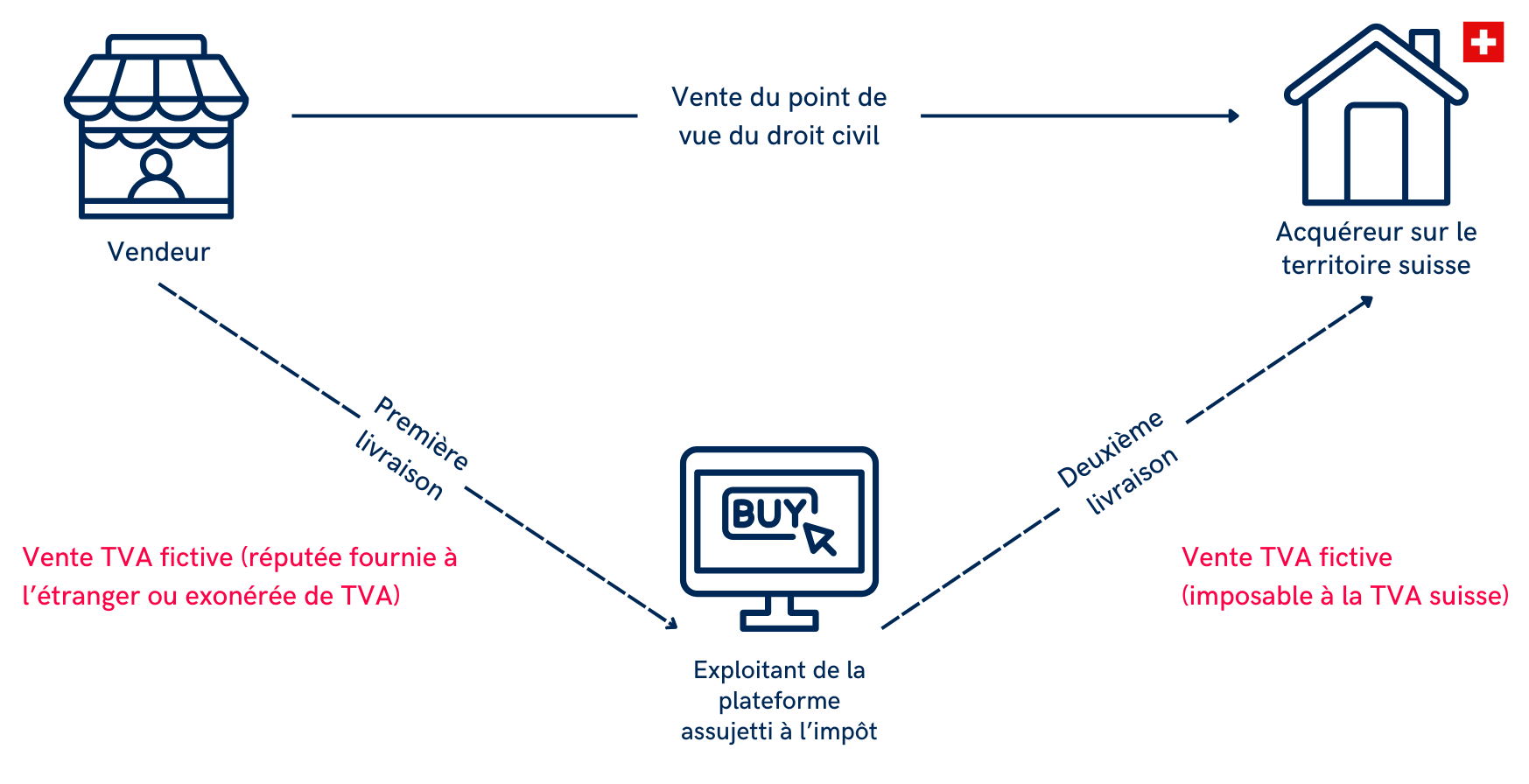
In the event of importation into Swiss territory, the Swiss or foreign platform, subject to VAT in Switzerland, will be considered the importer of the goods into Switzerland.
She will have to:
- Charge VAT on all deliveries made in Switzerland.
- Pay import VAT with the option to defer payment of the tax (to limit cash flow impacts)
Platforms will not be able to apply the net tax debt rate method.
This fiction only applies to contracts/sales concluded after 1 January 2025.
Exemptions
The platforms are not concerned by the new regulation if:
-
- They do not participate, either directly or indirectly, in the ordering process.
- They do not generate revenue in relation to the transaction (example: an online shop for a single company).
- They are limited to activities such as processing payments, promoting or redirecting buyers to other digital platforms without further involvement in delivery.
Invoicing and counter-performance to declare
In the case of a legal fiction of a «double transaction», both the platform and the seller can issue the invoice to the customer.
If the invoice is issued by the platform operator, they may do so in their own name or in the seller's name. If VAT is indicated on this occasion, the AFC recommends adding a corresponding reference to Art. 20a LTVA.(3)
If the seller of the goods issues an invoice to the buyer and includes VAT on it, it must be stated that this is a transaction under Art. 20a of the Value Added Tax Act (LTVA) with reference to the platform operator (for example, in the form «VAT 8.1% % transferred in accordance with Art. 20a LTVA by [name and VAT number of the platform operator]»).(4) If the seller charges VAT and omits the above clarification, they are liable for the VAT mentioned.
The amount received by the platform operator, who is VAT registered, as commission is not considered consideration for a supply. The operator therefore does not need to additionally charge VAT on this amount. The transaction should therefore be declared as follows:
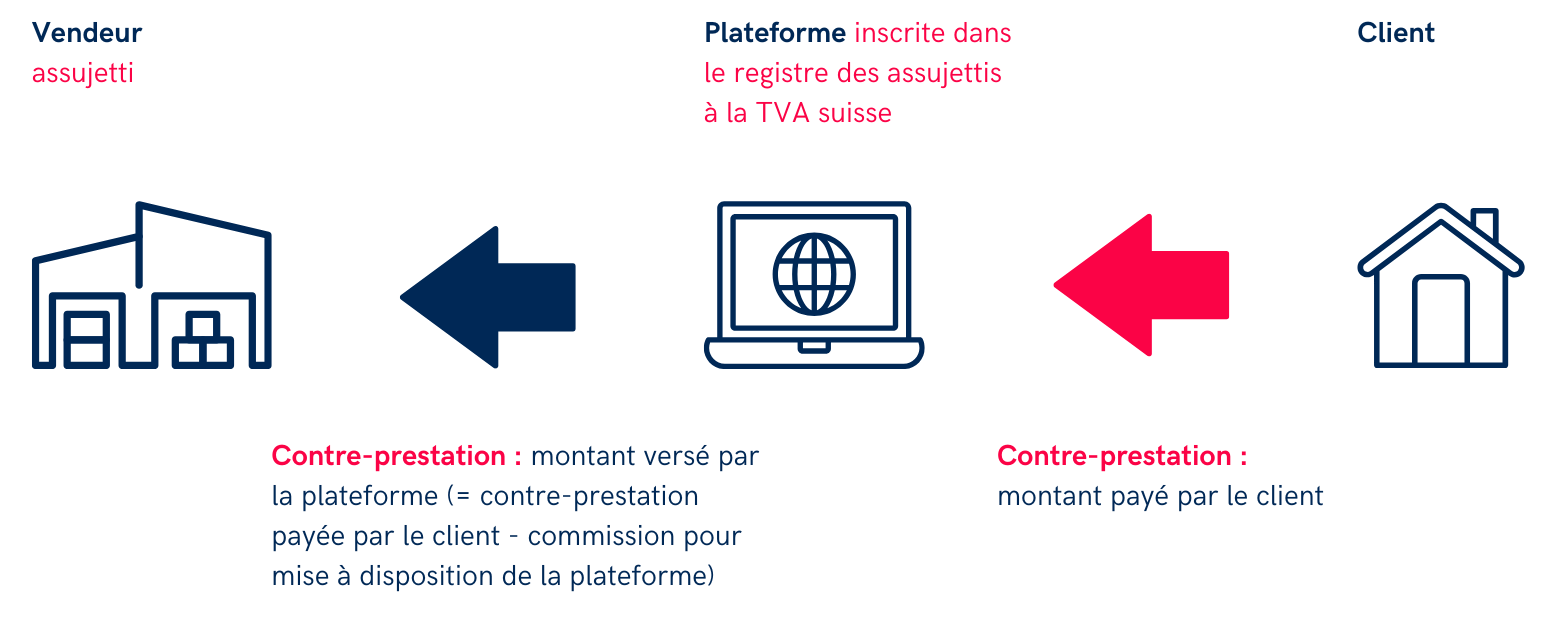
The platforms will have to establish a detailed statement of the services they have provided, distinguishing between their own services and services under Article 20a LTVArév.
Simplification for suppliers
This new responsibility for platforms could mean that suppliers/sellers will no longer have a VAT obligation in Switzerland. Indeed, suppliers/sellers using digital platforms and who do not meet or no longer meet the criteria for Swiss VAT registration will now be exempt from the obligation to register for VAT or may request to be removed from the VAT Register (removal backdated to 31 December 2024 if the request is made before 28 February 2025).
Recommendations
We recommend that digital platform operators and suppliers/sellers:
Assess their VAT registration status (particularly for foreign sellers who may avoid liability or request deregistration).
Prepare for the new declarative and administrative obligations and for import VAT payments (where applicable, evaluate the possibility of applying postponed import VAT accounting).
Adjust accounting systems and invoices.
Inform their customers to maintain a seamless shopping experience.
For more information and a detailed analysis of the impact of this reform on your business, please contact our tax experts.
Source :
1. VAT Info 27 concerning the Digital Platforms sector https://www.gate.estv.admin.ch/mwst-webpublikationen/public/pages/sectorInfos/tableOfContent.xhtml?label=true2.
2. VAT Info 27 concerning the digital platforms sector, ch. 1.3.1
3. VAT Info 27 concerning the digital platforms sector, ch. 2.7
4.VAT Info 27 concerning the digital platforms sector, ch. 2.7
Latest news

Vote on 27 September: Initiative 12% – what you need to know
On 27 September, the people of Vaud will vote on the «12%» initiative, which proposes a 12% reduction in cantonal tax on income, wealth and capital gains. What you need to know before voting.

Annual VAT reconciliation
Annual VAT reconciliation is compulsory for all taxable businesses in Switzerland. Find out why it's essential, what the deadline is and how our experts can help you avoid errors and penalties.

Business Intelligence comes to the World Cup
Four collaborators have built a near real-time scoreboard for the internal World Cup predictions. A project that perfectly illustrates the Berney Insights approach: making data readable, dynamic, and shared.
 Français
  English (UK)
  Deutsch