
HR News for 2026

Introduction
The year 2026 marks an important milestone in human resources and social legislation in Switzerland.
Between the introduction of the 13th AHV pension, the entry into force of the new framework for cross-border remote working, the adjustment of cantonal social contributions, as well as several tax and social developments in Geneva, employers will have to adapt to a changing regulatory environment. This overview presents the main changes to be aware of and anticipate for 2026, for both employers and employees.
AVS: vote on the 13th pension
On 3 March 2024, the Swiss people approved the introduction of a 13th AHV pension, which will come into effect from January 2026, with the first payment due in December 2026. This supplementary pension, paid automatically with the December AHV pension, corresponds to one-twelfth of the annual old-age pension. Its final amount will be calculated at the end of the year, as the pension may change during the year.
Only old-age pensions are concerned. Supplementary pensions, child pensions and certain supplements, particularly those related to the AHV 21 reform, are excluded from the calculation. All individuals receiving an old-age pension in December will benefit automatically, while survivor's and disability pensions will continue to be paid 12 times a year.
Remote working for cross-border workers
As of 1st January 2026, the amendment to the Franco-Swiss tax treaty will come into effect and will officially regulate cross-border teleworking, following its ratification by France in 2025. It confirms that individuals domiciled in France and working in Switzerland will be able to continue teleworking. up to 40% of their annual working time from France, including up to 10 days of temporary assignments, while remaining taxed in Switzerland. In return, Switzerland will pay financial compensation to France, and the tax authorities of both countries will automatically exchange salary data.
For Swiss employers, this implies a new reporting obligation: they will have to transmit to the Federal Tax Administration the rate of remote working actually carried out by each employee residing in France. This information will have to be communicated separately from the salary certificate, at the beginning of the year for the previous year. The first transmission is planned for early 2027 for the 2026 data.
Adjustment of LAMat contributions and family allowances from 1 January 2026
From 1 January 2026, the contribution rates for cantonal maternity insurance and family allowances in Geneva will be lowered :
Cantonal Maternity Insurance (LAMat)
- Equalisation rate 0,058 % wages and income subject to AHV (0.064 % in 2025)
Family allowances (AF GE)
- Contribution rate 2,22% (2.25 % in 2025)
Employees
- Family benefits 2,22% solely at the employer's expense
- Maternity insurance 0,058% divided equally -> 0.029% employer / 0.029% employee.
Withholding tax Geneva: change concerning the tax statement-receipt
From January 2025, Geneva-based employers can no longer directly include the withholding tax receipt in the salary certificate affected employees. For persons subject to withholding tax in Geneva, the attestation-quittance must now (or again) be drawn up and transmitted separately, either in paper format or electronically. This attestation remains mandatory and must be given to each person subject to withholding tax no later than 31 January of the following year, or at the end of their tax liability. The salary certificate can therefore no longer serve as proof for withholding tax, even when it is drawn up using payroll software.
AHV 21 Reform: Situation as of 1 January 2026 for women
On 1 January 2026, the AHV 21 reform enters its second stage of raising the retirement age for women. On this date, the retirement age will be set at 64 years and 6 months for women born in 1962. This increase is part of the gradual process planned between 2025 and 2028, aiming to harmonise the reference age for women and men at 65.
In order to mitigate the effects of this change, compensatory measures are planned for women of the transitional generation, born between 1961 and 1969.
These benefit either from more favourable reduction rates in the event of early receipt of an AVS pension, or from a lifelong pension supplement when they retire at the reference age or later. The type and amount of compensation depend in particular on the year of birth and the average income.
Preferential discount rates where annuity is anticipated
Women born between 1961 and 1969 – transitional generation
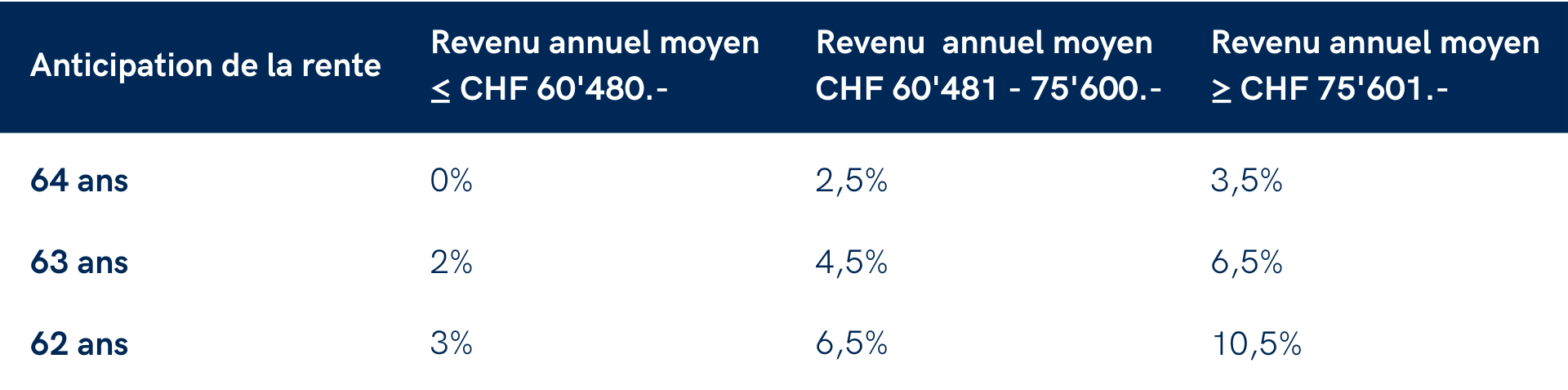
These rates are applied for life and are more favourable than ordinary rates.
No child's pension is paid during the period of early receipt.
2. Supplementary pension – AHV for women retiring at or after the reference age
(Women born between 1961 and 1969)
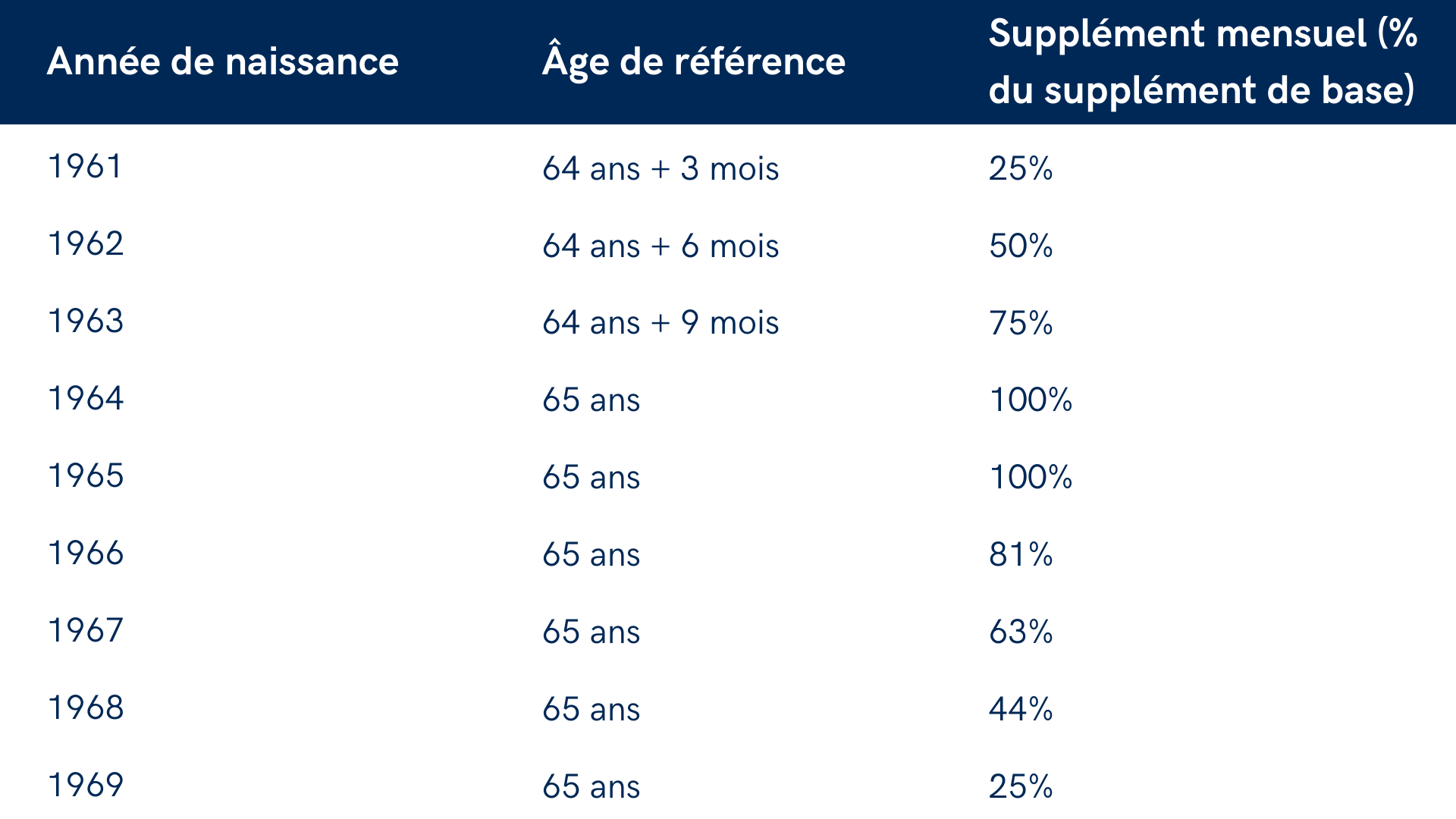
The basic supplement depends on the average annual income
- CHF 160 (income ≤ CHF 60,480)
- CHF 100.- (income CHF 60,481 – 75,600.-)
- £50 (income ≥ £75,601)
This supplement is paid for life.
Minimum wage
The minimum wage applies to all persons working on Genevan soil, with the exception of apprentices, trainees (as part of schooling or professional training) and minors. Occasional professional activities of students over 18 years of age, «student jobs», are excluded from the scope of the minimum wage if the activity is covered by a collective labour agreement and if the following cumulative conditions are met:
- The student is registered with a training establishment
- The activity takes place during the training establishment's holiday period
- The activity does not exceed sixty continuous days per calendar year
- Salaries are set by the relevant joint committee
For the year 2026, the Geneva minimum wage amounts to £24.59 per hour.

Latest news

Why use a broker for your business?
After nearly 20 years in insurance, Julien Gourdet joined Berney Associates to develop new expertise in brokerage. He explains why a company benefits from using a broker, how he supports his clients, and what sets him apart from an insurance agent.

Business insurance: too late to review your contracts?
Your company’s insurance contracts are coming to an end and the termination period has passed? Many companies think they have to wait another year. However, a premium increase or a negotiated postponement often allow you to act even sooner. Here’s how to check your options and prepare for a competitive bid in good conditions.

New ruling on real estate VAT
In a decision dated August 27, 2026, the Federal Court confirms that the registration in the land registry is decisive in the field of real estate VAT. A review of the case and the points to be considered in your projects.
 Français
  English (UK)
  Deutsch