
Vote on 27 September: Initiative 12% – what you need to know

Will the people of Vaud vote in favour of a tax cut?
During the federal and cantonal referendums on 27 September, the people of Vaud will vote on the so-called «12%» initiative, which aims to ease the tax burden on taxpayers in Vaud. If approved, its effects could be felt as early as next year. The result of the vote will also have implications for the application of the Vaud tax cap.
The «12%» initiative»
Launched in 2022 by a committee comprising members of the public, elected representatives and representatives from the business community in Vaud, the «12 %» initiative aims to reduce the tax burden on taxpayers in Vaud in order to improve their purchasing power.
According to the proposers, taxpayers in Vaud bear an excessively high tax burden compared with other cantons. The canton of Vaud is, in fact, one of the Swiss cantons that imposes the highest levels of taxation on individuals. The initiative aims to correct this imbalance in part by providing for a 12 % reduction in cantonal tax on income, wealth and lump-sum payments (such as pension lump-sum payments from the 2nd or 3rd pillar a).
The arguments of the initiators
Supporters of the initiative highlight the particularly high level of taxation in the canton of Vaud compared with other cantons. They cite in particular the example of the canton of Zurich which, despite having an economic and demographic structure comparable in several respects to that of Vaud, applies more moderate taxation.
According to them, this situation must be rectified in order to breathe new life into the Vaud middle class, which is faced with a continuous rise in many everyday expenses, such as housing, energy, transport and health insurance premiums.
The initiators also argue that their proposal is simple and easy to implement. The resulting decrease in cantonal tax revenue would remain manageable given the current healthy state of Vaud's finances. They also point out that municipal tax revenue would not be affected, since the reduction submitted to the vote relates solely to cantonal tax.
Finally, supporters believe that a tax cut would have a tangible effect on household purchasing power, with positive impacts expected on consumption and, more broadly, on the Vaud economy.
The arguments of the opponents
Opponents of the initiative, for their part, put forward several criticisms.
They consider first that the measure would disproportionately benefit the wealthiest taxpayers, given that the tax relief would automatically be greater for large incomes and fortunes.
They further consider that a drop in cantonal revenues could eventually lead to budget trade-offs that are unfavourable to the public, for example in the form of cuts to public services, increased pressure on certain subsidies or an increase in certain costs borne by households.
Opponents also fear that the initiative will help to increase inequalities within the canton by granting a more marked advantage to the best-off taxpayers.
Finally, it should be noted that the Grand Council and the State Council of Vaud recommend rejecting this initiative. The authorities consider that the measures taken recently and the 7% reduction in cantonal income tax, which will come into force in 2027, are already sufficient. The authorities also believe that a 12% reduction would be too large and would jeopardise public services.
What tax cut in the event of a yes vote?
In order to illustrate the tax implications of the «12 %» initiative, particularly for the middle class in Vaud, various scenarios have been analysed and are set out below. A comparison with the canton of Zurich also helps to put into perspective the difference in personal taxation between these two cantons.
The table below compares three situations. The simulations take into account only cantonal and municipal income and wealth tax.
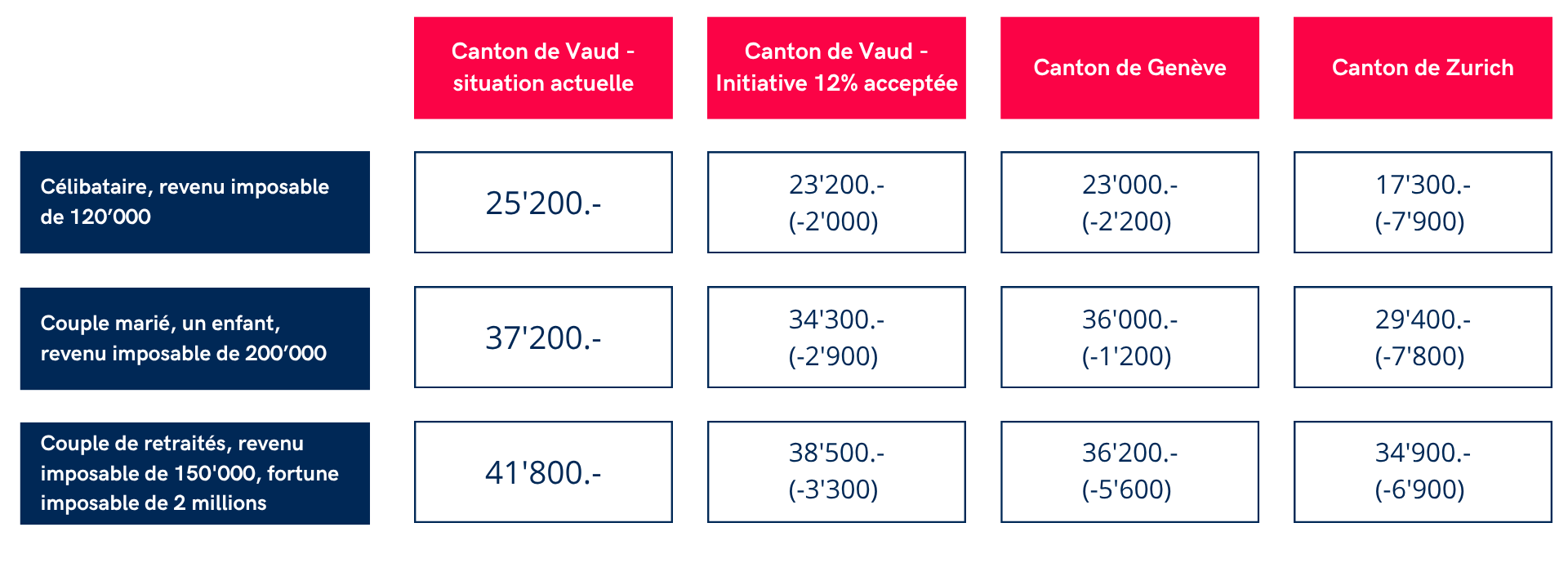
It emerges from these comparisons that the Vaud middle class is, generally speaking, more heavily taxed than in Geneva and Zurich. The difference in taxation with Zurich is, however, much more marked.
For example, a married couple with one child and an income of CHF 200,000 currently pay nearly CHF 8,000 more in taxes in the canton of Vaud than in Zurich. A comparable gap can also be observed for single people and retired couples.
If accepted, the initiative could therefore help to partially reduce this gap and ease the tax burden for many Vaud taxpayers. Even after such a cut, the canton of Vaud would nevertheless remain among the cantons where personal income tax is the heaviest.
What impact on the Vaud tax shield?
As a reminder, the Vaud tax cap is a mechanism designed to cap the cantonal and municipal tax burden at 60 % of net income.
In December 2024, the Vaud Grand Council adopted amendments to the Municipal Taxes Act relating to this mechanism. These changes aim to restore the application of the tax cap to a system similar to that which prevailed before 2022 and which was more favourable to taxpayers. However, the legislature has attached a so-called «guillotine clause» to this reform: the legislative amendment would only come into force if the ‘12 %’ initiative were rejected.
In practice, this means that:
-
- if the initiative is accepted, the tax shield system applied since the 2022 tax period would remain in force; ;
- if the initiative were rejected, the previous system would be reintroduced.
Depending on the circumstances, this return to the previous system could produce different effects for the taxpayers concerned. Some might see their tax burden decrease, whereas others could, on the contrary, experience an increase in their taxation. We note that an individualised analysis is necessary to precisely estimate the tax consequences of either method of calculating the tax shield.
Conclusion
The «12 %» initiative has the advantage of having a clear objective and being relatively straightforward to implement. It addresses a very real concern amongst some taxpayers in the Canton of Vaud: the high level of cantonal taxation compared with other Swiss cantons, particularly those in German-speaking Switzerland, which is putting a strain on purchasing power.
On 27 September, the citizens of Vaud will therefore have to choose between i) granting immediate tax relief to support purchasing power, or ii) prioritising budgetary prudence in order to safeguard the canton's tax revenues.
If the result is a ’yes’ vote, this referendum could also have negative consequences for taxpayers benefiting from the tax cap, who number between 3,000 and 4,000 in total – less than 1% of taxpayers in the Canton of Vaud.
Latest news

Annual VAT reconciliation
Annual VAT reconciliation is compulsory for all taxable businesses in Switzerland. Find out why it's essential, what the deadline is and how our experts can help you avoid errors and penalties.

Business Intelligence comes to the World Cup
Four collaborators have built a near real-time scoreboard for the internal World Cup predictions. A project that perfectly illustrates the Berney Insights approach: making data readable, dynamic, and shared.

Raphaël Leveau co-authors a white paper on business succession in Switzerland
For the 5th anniversary of the Swiss Association of Business Transfer Experts, our partner Raphaël Leveau co-authored a white paper on the Swiss M&A market, featured in PME magazine.
 Français
  English (UK)
  Deutsch